Pockets didn’t like math
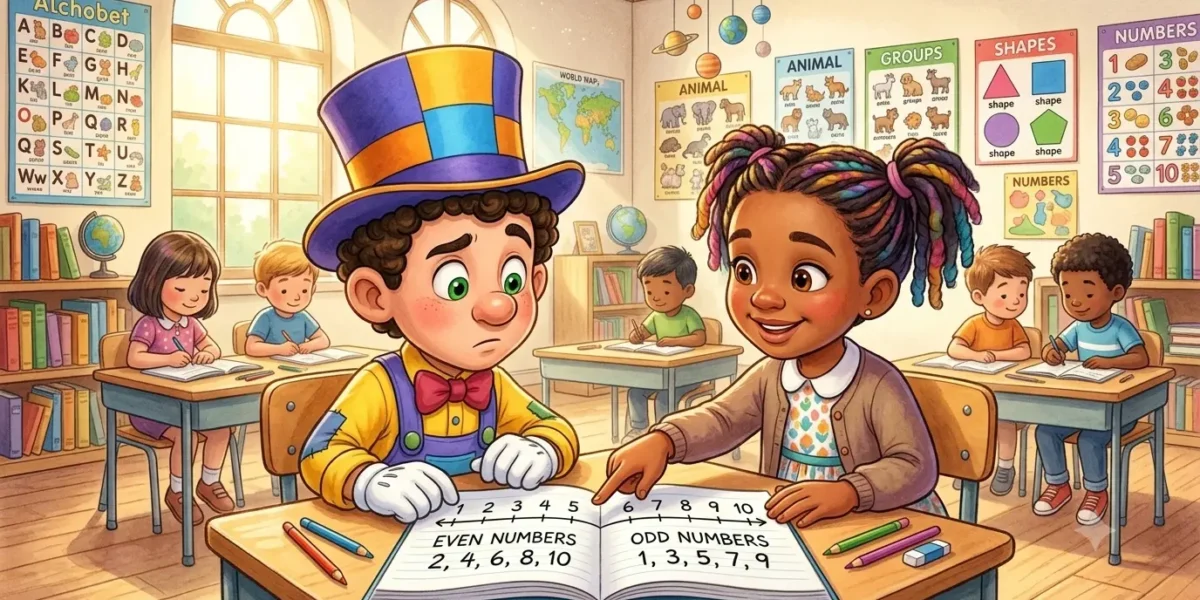
Every time the teacher wrote numbers on the board, his mind felt like it was getting tangled in strings. Symbols, lines, plus signs, minus signs – it all looked like a secret code he couldn’t crack.
“Math is too hard,” Pockets sighed one afternoon, resting his head on his desk. “English makes sense… but math? It just doesn’t stick.”
He remembered something his teacher once said: Real learning doesn’t happen overnight. Pockets repeated it quietly to himself, trying to believe it.
But still… he struggled.
That day, instead of giving up completely, he tried something new. He looked at the number line drawn in his notebook.
1, 2, 3, 4, 5, 6, 7, 8, 9, 10…
He tapped each number slowly with his pencil. “Maybe I’m making it too complicated,” he thought. “Maybe it should be simple… like 1, 2, 3… like a song.”
He even hummed softly, like the old “ABC” tune, trying to feel the rhythm of numbers. For a moment, it helped.
Then he saw something else:
Even numbers: 2, 4, 6, 8, 10
Odd numbers: 1, 3, 5, 7, 9
Pockets frowned. “Why are there categories now?”
Just then, his smart friend appeared. She was calm, patient, and always good at explaining things step by step. Her name was Mukur.
Mukur pulled up a chair beside him. “You’re not bad at math,” she said. “You’re just trying to learn it all at once. Let’s slow it down.”
Pockets looked up. “But there are so many tricks… number lines, even and odd, rules… I get confused.”
Mukur smiled. “Start with the basics. Always.”
She pointed at the numbers. “1 to 10. Just know them first. Don’t rush. Like building blocks – you can’t build a tower without the bottom layer.”
Pockets listened.
Mukur continued, “Even numbers are just numbers you can split into two equal groups. Odd numbers always have one left over. That’s it. No magic, just patterns.”
Pockets tried again. “So… 6 can be split evenly, but 7 can’t?”
Mukur nodded. “Exactly.”
Something clicked.
Pockets slowly realized he wasn’t bad at math – he was just skipping steps. He had been trying to jump to the top of the ladder without climbing it.
That day, he didn’t finish everything. But he understood something more important: learning takes patience, and every hard subject becomes easier when you respect the basics.
As he packed his books, Pockets smiled a little. “Maybe math isn’t the enemy,” he said. “Maybe I just needed a better start.”
Mukur stood up. “And you just got it.” Big problems become small when you start with the basics, stay patient, and don’t be afraid to ask for help.

Pockets and Mukur Visit Spain
One sunny morning, Pockets and Mukur were packing their bags, ready for a grand adventure. The…

Lil Squeak and the Witch of the Winding Roads
Once upon a time, in a land where the roads twisted and turned like colorful ribbons,…

Pockets and the Parade of Patience
The morning of the big Parade of Patience had finally arrived, and Pockets bounced out of…
Keep the Magic Alive
Enjoyed this story? Help Pockets create more!
Pockets & Friends is on a mission to fill children’s hearts with good values — through stories, songs, and games. We’re a passion project, not a big company. Every single donation helps us keep the lights on and bring more kindness, courage, and honesty into the world.
🔒 Secure payment via Stripe · No account needed · Cancel anytime